> ## Documentation Index
> Fetch the complete documentation index at: https://docs.tess.im/llms.txt
> Use this file to discover all available pages before exploring further.
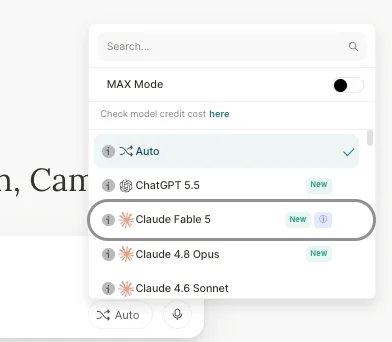
# Claude Fable 5 (Anthropic)
The Claude Fable 5 is an advanced AI model by Anthropic, designed for complex reasoning tasks, long-form content generation, and deep contextual analysis. It stands out in scenarios that require narrative consistency, interpretation of large volumes of information, and more “structured” responses.
It is ideal for users who need high quality — but requires special attention to credit consumption and data retention.
| **Model ID**
claude-fable-5 | **Context Window**
300k | **Max Context**
1M | **Provider**
Anthropic |
| :--------------------------------------------------------------------------------------------- | :--------------------------------- | :---------------------------- | :----------------------------------- |
| **Capabilities**
| **Speed**
Medium | **Cost**
High | **Intelligence**
Frontier |
Claude Fable 5 is a model from the Claude family focused on:
* Advanced reasoning and long context
* Generation of extensive and coherent texts
* Detailed document analysis
* More natural and consistent interactions
In practice, it works as a premium model within the Tess ecosystem, recommended for tasks where lighter models cannot maintain quality or depth.
 ### **Model Details**
Fable 5 supports large volumes of information in the same prompt, allowing:
* Analyze long documents
* Maintain coherence in extended conversations
* Work with multiple sources at the same time
However, the larger the input + output, the higher the credit consumption and, naturally, very large contexts may increase latency
This model is more expensive than standard models.
Factors that impact cost:
* Prompt size (input tokens)
* Response size (output tokens)
* Continuous use in long conversations
In this case, choose this model when you want higher quality in specific and strategic tasks, opting for smaller models for volume and simple tasks.
Anthropic models may have specific data retention policies depending on the type of usage. See more details here ([link](https://trust.anthropic.com/resources?s=7ksqkied5hn0pocsj206m\&name=%5Banthropic%5D-security-and-privacy-design-of-anthropic-data-retention-and-review)).
When using Claude Fable 5, it is important to understand how the data sent in the prompt may be handled. In general, the model processes all included information:
* Text typed in the prompt
* Attached files
* Conversation history (context window)
In this case, the data may be temporarily processed to generate the response and also stored for model improvement or monitoring
This can be risky if **sensitive data** is sent (e.g., confidential contracts, personal data) to the model, or when used in **regulated environments** (legal, financial, healthcare), and even when **sharing internal company information** without access control.
To mitigate risks:
* Avoid sending sensitive data unless necessary
* Anonymize information whenever possible: Ex - replace names, emails, IDs
* Use explicit instructions in the prompt: *"Do not retain or reuse this information outside of this analysis."*
* Prefer working with summaries or excerpts instead of full documents
**Access control**
In enterprise environments, it is possible to limit which models are available to users, allowing this model to be strategically restricted to avoid sharing sensitive data or incurring high costs.
### **Pricing and credit consumption**
Claude Fable 5 is a premium model and tends to have a higher cost than lighter or general-purpose models. Therefore, it should mainly be used for tasks that truly require greater reasoning capability, long context, or response quality.
Usage cost is typically influenced by:
* **Input tokens:** prompt size, attached files, and conversation history.
* **Output tokens:** size of the response generated by the model.
* **Long context usage:** the more information sent to the model, the higher the consumption tends to be.
In Tess, this consumption can directly impact account credits, especially when the model is used with large documents, long responses, or at high volume.
See the model cost by inputs, outputs, and prompt cache reads:
| Name | Input Token | Cache Write | Cache Read | Output |
| :------------- | :---------- | :---------- | :--------- | :------ |
| Claude Fable 5 | \$10 /M | \$12.5 /M | \$1 /M | \$50 /M |
**Best Practices for Using the Model**
* Be specific in the prompt: the more context, the better the result
* Avoid using it for simple tasks: examples - basic classification, short responses
* Control the response length: Ex - “summarize in up to 300 words”
* Use attachments with clear intent: specify exactly what the model should do with the material
* Monitor credit consumption: especially in automations or large-scale usage
Claude Fable 5 is a powerful choice for tasks that require depth, context, and output quality.
Use it strategically: combine it with cheaper models for everyday use and reserve Fable 5 for situations where it truly makes a difference — especially considering cost and retention policies.
### **Model Details**
Fable 5 supports large volumes of information in the same prompt, allowing:
* Analyze long documents
* Maintain coherence in extended conversations
* Work with multiple sources at the same time
However, the larger the input + output, the higher the credit consumption and, naturally, very large contexts may increase latency
This model is more expensive than standard models.
Factors that impact cost:
* Prompt size (input tokens)
* Response size (output tokens)
* Continuous use in long conversations
In this case, choose this model when you want higher quality in specific and strategic tasks, opting for smaller models for volume and simple tasks.
Anthropic models may have specific data retention policies depending on the type of usage. See more details here ([link](https://trust.anthropic.com/resources?s=7ksqkied5hn0pocsj206m\&name=%5Banthropic%5D-security-and-privacy-design-of-anthropic-data-retention-and-review)).
When using Claude Fable 5, it is important to understand how the data sent in the prompt may be handled. In general, the model processes all included information:
* Text typed in the prompt
* Attached files
* Conversation history (context window)
In this case, the data may be temporarily processed to generate the response and also stored for model improvement or monitoring
This can be risky if **sensitive data** is sent (e.g., confidential contracts, personal data) to the model, or when used in **regulated environments** (legal, financial, healthcare), and even when **sharing internal company information** without access control.
To mitigate risks:
* Avoid sending sensitive data unless necessary
* Anonymize information whenever possible: Ex - replace names, emails, IDs
* Use explicit instructions in the prompt: *"Do not retain or reuse this information outside of this analysis."*
* Prefer working with summaries or excerpts instead of full documents
**Access control**
In enterprise environments, it is possible to limit which models are available to users, allowing this model to be strategically restricted to avoid sharing sensitive data or incurring high costs.
### **Pricing and credit consumption**
Claude Fable 5 is a premium model and tends to have a higher cost than lighter or general-purpose models. Therefore, it should mainly be used for tasks that truly require greater reasoning capability, long context, or response quality.
Usage cost is typically influenced by:
* **Input tokens:** prompt size, attached files, and conversation history.
* **Output tokens:** size of the response generated by the model.
* **Long context usage:** the more information sent to the model, the higher the consumption tends to be.
In Tess, this consumption can directly impact account credits, especially when the model is used with large documents, long responses, or at high volume.
See the model cost by inputs, outputs, and prompt cache reads:
| Name | Input Token | Cache Write | Cache Read | Output |
| :------------- | :---------- | :---------- | :--------- | :------ |
| Claude Fable 5 | \$10 /M | \$12.5 /M | \$1 /M | \$50 /M |
**Best Practices for Using the Model**
* Be specific in the prompt: the more context, the better the result
* Avoid using it for simple tasks: examples - basic classification, short responses
* Control the response length: Ex - “summarize in up to 300 words”
* Use attachments with clear intent: specify exactly what the model should do with the material
* Monitor credit consumption: especially in automations or large-scale usage
Claude Fable 5 is a powerful choice for tasks that require depth, context, and output quality.
Use it strategically: combine it with cheaper models for everyday use and reserve Fable 5 for situations where it truly makes a difference — especially considering cost and retention policies.