> ## Documentation Index
> Fetch the complete documentation index at: https://docs.tess.im/llms.txt
> Use this file to discover all available pages before exploring further.
# GPT-6 Astra
GPT-6 Astra (OpenAI) is the most capable OpenAI model in Tess — built for **the hardest end-to-end work**: complex reasoning, software engineering, computer use, research, and document creation.
| **Model ID**
`gpt-6-astra` | **Context**
1.05M input / 128K output | **Provider**
OpenAI | **Released**
3 Sep 2026 |
| :------------------------------------------------------------------------------------------- | :----------------------------------------------- | :----------------------------- | :----------------------------------- |
| **Capabilities**
| **Speed**
Fast | **Cost**
High | **Intelligence**
Frontier |
## What changed vs GPT-5.6 Sol
| | GPT-5.6 Sol | GPT-6 Astra |
| ------------------------- | -------------------------- | ------------------------------------------------------ |
| Focus | Flagship of the 5.6 family | Hardest end-to-end work (coding, agents, computer use) |
| Context | 1.05M / 128K | 1.05M / 128K |
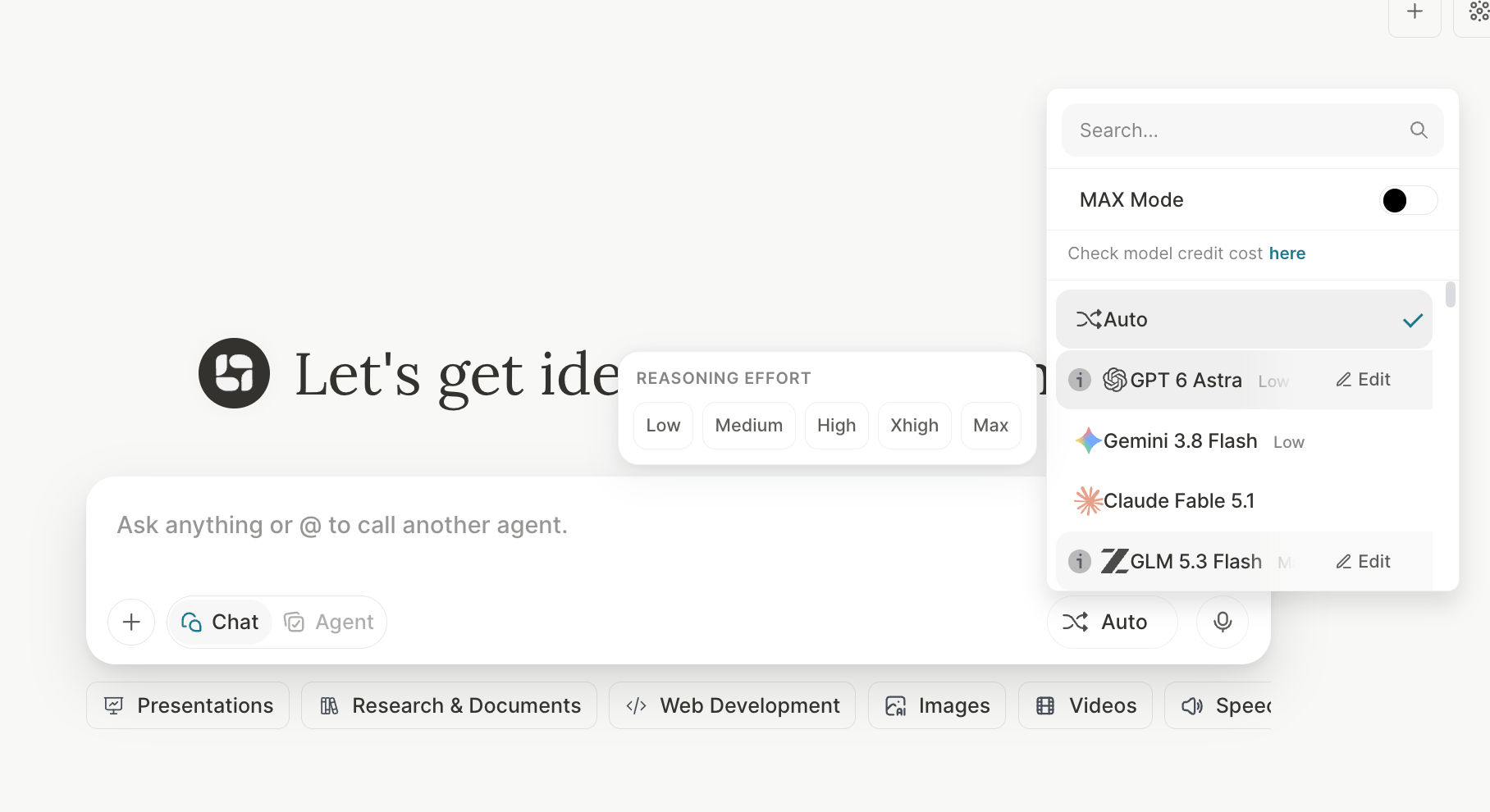
| Reasoning effort | low / medium / high | **low / medium / high / xhigh / max** |
| Input → output | Text + image → text | Text + image → text |
| Tess credits / 100 tokens | 0.224 in / 1.120 out | **0.44 in / 2.2 out** |
Native **reasoning**, **tools** (function calling / MCP, search, computer use), and **image input**. One Tess key — `gpt-6-astra` — not a fourth GPT-5.6 SKU.
## Pricing (Tess credits)
Values follow [Models and Costs](/en/models-and-cost) (credits per 100 tokens):
| Model | Input / 100 tokens | Output / 100 tokens |
| ------------------------------------------------------ | ------------------ | ------------------- |
| GPT-6 Astra
*(Low, Medium, High, xHigh and Max)* | 0.44 | 2.2 |
 ## How to apply GPT-6 Astra in Tess
The gain appears when the agent gets more than a question: **an objective, company context, the right tools, and a clear definition of done**. Astra can then carry the work across files, systems, and decisions until it reaches the deliverable.
Describe what must exist at the end: an updated CRM, a memo in the company template, a finished presentation, or a code change that passes its tests.
Attach reference files and make the required tools or connectors available. Without access to the system, the model can guide the action but cannot perform it there.
State what it may change, when it must request confirmation, and which conditions it must verify before finishing.
Use **medium** for known workflows, **high** for complex analysis and execution, and **xhigh/max** when depth and verification justify more time and tokens.
## Three playbooks to get started
### 1. A sales follow-up that ends in the CRM
**Input:** meeting transcript, account data, and qualification rules.
## How to apply GPT-6 Astra in Tess
The gain appears when the agent gets more than a question: **an objective, company context, the right tools, and a clear definition of done**. Astra can then carry the work across files, systems, and decisions until it reaches the deliverable.
Describe what must exist at the end: an updated CRM, a memo in the company template, a finished presentation, or a code change that passes its tests.
Attach reference files and make the required tools or connectors available. Without access to the system, the model can guide the action but cannot perform it there.
State what it may change, when it must request confirmation, and which conditions it must verify before finishing.
Use **medium** for known workflows, **high** for complex analysis and execution, and **xhigh/max** when depth and verification justify more time and tokens.
## Three playbooks to get started
### 1. A sales follow-up that ends in the CRM
**Input:** meeting transcript, account data, and qualification rules.
**Tools:** CRM and calendar connected to the agent.
**Suggested setup:** **medium** or **high** effort; confirmation before sending messages or changing an opportunity.
```text theme={null}
Analyze the meeting and identify decisions, objections, owners, and deadlines.
Update the corresponding CRM fields, create the next tasks, and prepare the
follow-up. Before sending any message or changing the opportunity stage,
show the planned actions for approval.
```
**Done when:** the record is updated, every action has an owner and deadline, and the follow-up is ready. This is not meeting notes; it is the sales operation ready to move.
### 2. A legal file set that becomes an executive decision
**Input:** contracts, amendments, emails, internal policy, and the memo template.
**Tools:** company-file search and document generation.
**Suggested setup:** **high** or **xhigh** effort; mandatory citations and human review before legal use.
```text theme={null}
Compare the documents, build a timeline, and identify discrepancies,
obligations, risks, and amounts. Cite the file and passage supporting each
conclusion. Produce a memo in the supplied template and an executive summary
of the decisions required. Flag every gap; do not assume.
```
**Done when:** every conclusion traces back to a source, gaps are explicit, and the team receives the memo and summary in the format it actually uses.
### 3. A software change through passing tests
**Input:** repository, expected behavior, project standards, and test commands.
**Tools:** access to code, terminal, and test suite.
**Suggested setup:** **high** effort; **xhigh/max** for broad investigation or highly dependent changes.
```text theme={null}
Find the responsible flow, explain the cause before editing, and make the
smallest change that resolves the issue. Add or adjust the test that proves
the behavior, run the relevant suite, and fix regressions. Finish only with
a diff summary, the tests run, and the remaining risks.
```
**Done when:** the change is in the repository, the behavior is covered, and the relevant tests pass. This is not a suggested snippet; it is a verifiable change.
Astra can only perform actions allowed by the tools, connectors, and credentials available to the agent. Keep explicit human confirmation for irreversible or high-impact operations.
**Best practices**
* Reserve **GPT-6 Astra** for work that still fails on **GPT-5.6 Sol** or **Terra** — it is about **2×** Sol in Tess credits.
* Keep **GPT-5.6 Terra** / **Luna** for volume. Don’t use Astra as a cheap extractor.
* Effort goes up to **max**. Cap response length in the prompt when you don’t need a long deliverable.
See also: [Models and Costs](/en/models-and-cost) · [GPT-6 Astra (OpenAI)](https://openai.com/index/gpt-6-astra/).