What is it?
The Teams feature allows you to organize users in your workspace in a logical and hierarchical way (e.g., Marketing, Finance, Technology, CS). Instead of managing each employee’s rules individually, you create global rules for the Team — such as which AI models they can use and the group’s monthly credit budget. Anyone assigned to this group will automatically inherit the configured permissions, such as:- AI models authorized for use.
- Allowed data connectors (e.g., Google Drive, Notion, etc.).
- Maximum monthly quota of shared or individual team credits.
1
Access your Tess account.
It is important that you are logged in and that you are the workspace owner or a member with this permission.
2
In the side menu, click on Members (or Member Settings).
After clicking on your user icon, access settings and then members.
3
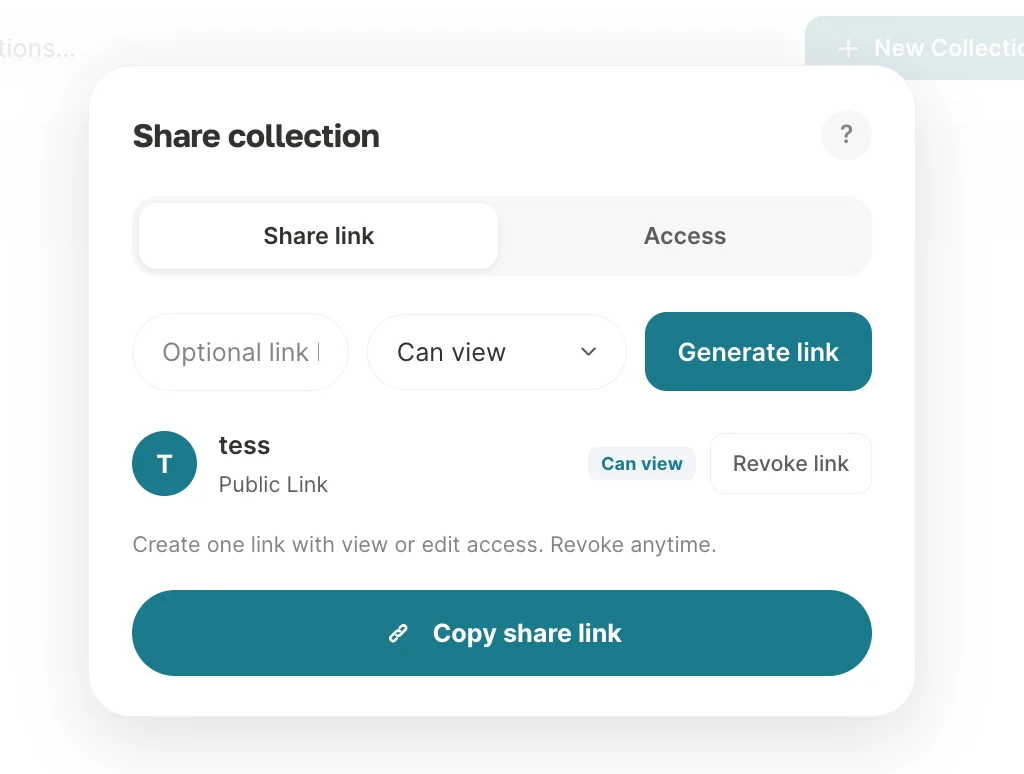
On the row of any active user, click under the Teams column (pencil icon or "+").
4
At the top right of the modal that opens, click the + Create new team button.

How to configure the team
- With the creation modal open, enter the group’s descriptive name in Team name (e.g., “Executive Marketing”, “Tech Developers”).
- In the Type field, select the group classification (e.g., Team or Department).
- In Part of (optional), you can define a hierarchy. If this group is subordinate to another, select the parent team (e.g., the “Performance” team is part of the “Marketing” department).

- Scroll down to the Advanced governance settings tab to define how this group operates:
- Connector access: Select whether this team can use all available connectors or restrict it to only allowed ones.
- AI model access: Define whether the group will have free access to run any AI model or be limited to specific models relevant to their work.
- Monthly credit limit: Set a credit consumption cap for the group.
- Click Create.

Understanding the Hierarchy (“Part of”)
When creating organizational structures in Tess, you can nest teams: Defining the “Parent Team” allows you to replicate governance rules from top to bottom in a simplified way, organizing records and monthly usage reports in a corporate manner.
- Horizontal Structure (No Parent): The team is autonomous. It has its own rules, which neither affect nor are affected by other groups. Ideal for small companies or areas with completely separate operations.
- Vertical Structure (Part of…): Useful for consolidating corporate governance. A child team (e.g., Chat Support) inherits the base policies of the parent team (e.g., Customer Experience). This ensures security in corporate data access and prevents junior analysts from accessing connectors beyond their scope.
Practical examples
- Setting up a Writing Team (Focus on Text AI):
- Configuration:
- Team Name: SEO Writers
- Connector access: Blocked (or only Google Docs allowed)
- AI model access: Allow only text-focused models with large context windows (e.g., Claude 3.5 Sonnet, GPT-4o Mini)
- Credit Limit: 100,000 credits/month per team user
- Configuration:
Important notes
- Rule inheritance: Any new member added to this team will instantly assume all the limitations and access defined in the advanced governance settings.
- Impact on consumption: The limit set for the team is recalculated at the beginning of each contractual billing cycle of your account.