

Why ask a single AI when you can consult the top three?Tess Consensus was developed exactly to solve this challenge.
So, what is Tess Consensus?
It is an agentic technology that orchestrates multiple AI models simultaneously, promoting a “conversation” between them. Instead of returning a single isolated answer, it conducts a collaborative process where the models analyze, refine, and validate their own outputs until reaching a more robust result.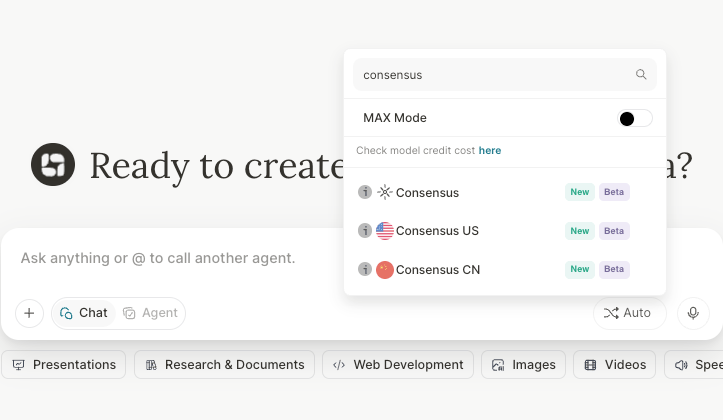
- Debate among themselves
- Adjust inconsistencies
- Converge on the best possible answer
The result is a delivery with higher quality, more consistency, and better performance.
Why “consensus” and not just comparison?
Comparing the answer of two isolated models is not enough to identify bias with statistical confidence. A single output does not necessarily represent the actual behavior of that model. Tess Consensus solves this by:- Running multiple models per group (e.g., models with greater Western or Eastern influence)
- Generating an internal consensus among them
- Producing a statistically more reliable result
- Consensus Global
- Consensus US
- Consensus China
Consensus only works in standard Chat Mode and not in Agent Mode.
Main features
Consensus Global
The top three global models work together to solve complex problems, combining their capabilities and reducing individual failures.
US vs China Consensus
Allows for a structured comparison of different worldviews — Western and Eastern — based on independent consensuses. This ensures a fairer and methodologically correct analysis.
How does this apply in practice?
TESS Consensus was not created for superficial curiosities like “how a Chinese or American model thinks”. It is a strategic tool, aimed at deeper decisions.Examples of use:
- HR strategies adapted to different cultures
- Definition of business personas with greater precision
- Market analysis with multiple perspectives
- Decision-making in complex and ambiguous scenarios
Why is this a game changer?
Tess Consensus transforms the way professionals use AI:- Moves from isolated answers to well-founded decisions
- Introduces transparency in the use of models
- Allows understanding and exploring different perspectives
- Raises the level of confidence in the answers
Create, test, and shareThe true potential of Tess Consensus appears when applied to real problems.Explore different consensuses, compare results, and observe how the transparency of the models directly impacts the quality of your decisions.