

What are Web Data Extraction Steps?
Steps are building blocks that you add to your agent’s logic in Agent Studio. The Web Data Extraction category groups a series of steps designed to perform searches across different online platforms.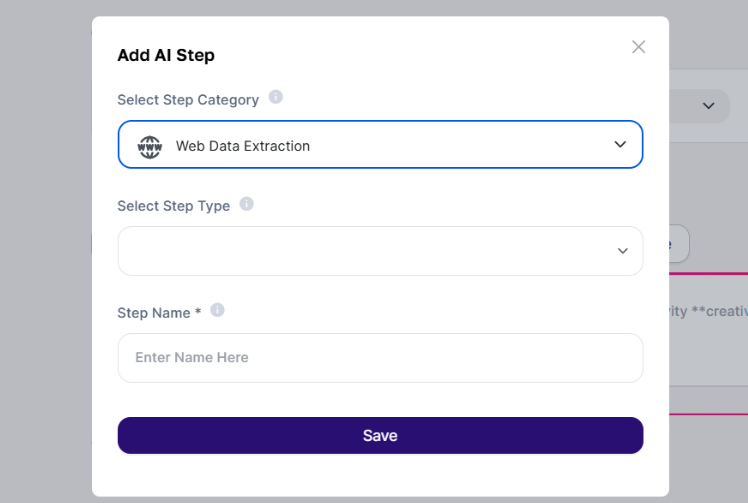
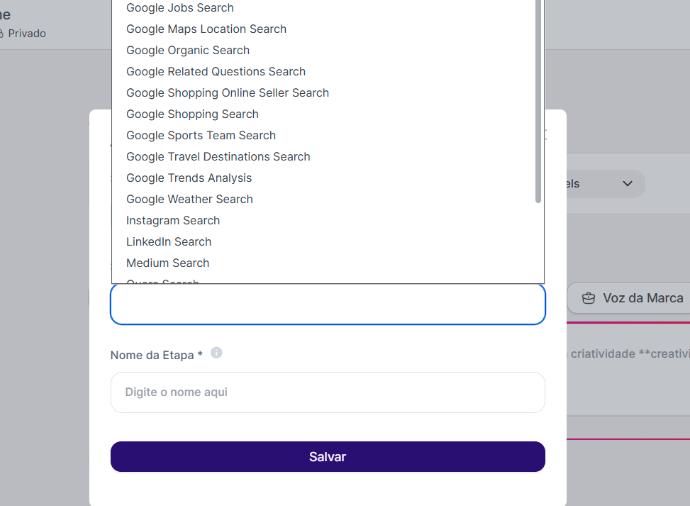
- Google Organic Search: For general searches, news, and information.
- Google Shopping Search: For searching products and comparing prices.
- Google Jobs Search: For finding job openings.
- Amazon Product Search: For searching products directly on Amazon.
- And many more.
How to Configure an Agent with Web Search
- Access Agent Studio and start creating or editing an agent.
- Add a Step: On the creation screen, locate the “AI Steps” section and add a new step.
- Select the Step Type: Choose the Web Data Extraction category and then the desired search type (e.g.: Google Shopping Search).
- Configure the Search: Fill in the search-specific fields. For example, the name of the product you want to search for. At this stage, you can choose to pre-configure some of the requirements as defaults, or use the user definition to create inputs and leave that field variable.
For example, if the domain always needs to be a specific country, you can configure it in advance. Or if the product must have a specific name, you can fill it in already. Otherwise, either activate the user decision or create inputs and reference them in the specific fields.
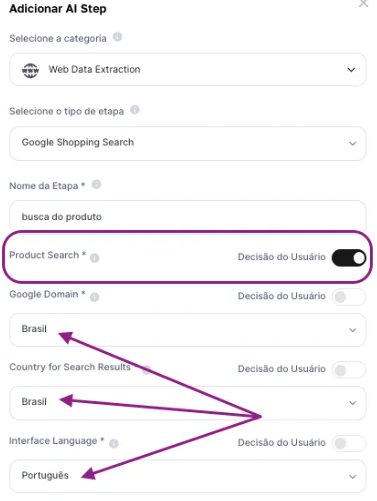
- Define the Step Name: This is a crucial step. Give a name to the result of your search (e.g.: product search). This name will become the variable you will use in your prompt to access the collected data.
With that, the search step is ready. Now, the secret is to connect this step to a good prompt.
Practical Example: Deals Search Agent
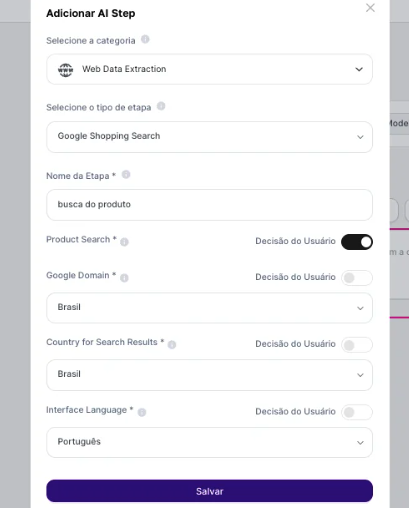
Let’s create an agent that finds the best deals on Google Shopping.Step Configuration:
- Step Type: Google Shopping Search
- Product Search: A variable can be used here
- Domain and Language: Based on your target market and language
- Step Name: product search
The Command Prompt (The Brain of the Operation)
The Step retrieves the raw information. Your prompt is what transforms that information into a useful and intelligent response.Suggested Prompt: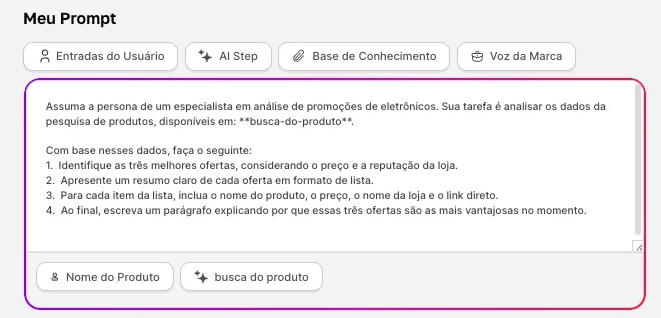
Assume the persona of an expert in electronics deals analysis. Your task is to analyze the product search data, available at: product-search. Based on that data, do the following:
- Identify the three best deals, considering the price and the store’s reputation.\
- Present a clear summary of each deal in list format.\
- For each item on the list, include the product name, the price, the store name, and the direct link.\
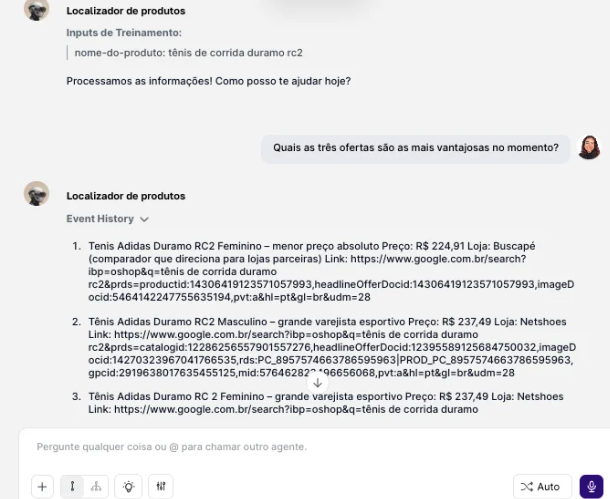
- At the end, write a paragraph explaining why these three deals are the most advantageous at this time.