

- you describe what you want to hear
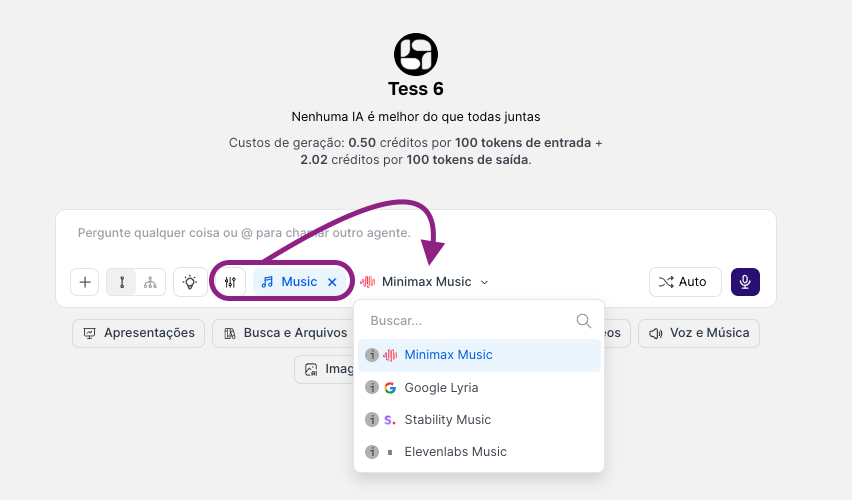
- you choose (when available) the music generation model
- you generate an original track
- you refine with new instructions until you reach the ideal result
You don’t need to know music theory, play an instrument, or use production software. The final quality depends mainly on how clear your prompt is.
Available models
Tess AI may offer different music generation models, for example:- Minimax Music
- Google Lyria
- Stability Music
- ElevenLabs Music
Use cases
- Custom background tracks for videos and lives
- Bumpers and jingles (brand, product, campaign)
- Music for institutional presentations
- Prototypes of musical ideas (melody, groove, mood)
- Content for social media (short loops, specific moods)
\
How to use the toolEnable the Tool
Enable it in Tess Chat, choose one of the models, and write a prompt (simple model).Use this formula:Genre + Instruments + Mood + Tempo/BPM + Duration + Structure referencesExamples:
- “Create a soft jazz instrumental with piano, bass, and drums, melancholic, 90 BPM, 60 seconds.”
- “Minimalist electronic track, synths and dry kick, futuristic atmosphere, 120 BPM, 30 seconds, with a short intro and a light drop.”
Ask it to generate and refine the result
Once you get the result, keep asking for specific adjustments, for example:
- Structure: “Make a 5s intro, then a catchy chorus, and end with a fade-out.”
- Energy: “Make the chorus more energetic and the verse calmer.”
- Instrumentation: “Remove the sax and add clean guitar with reverb.”
- Mix: “Lower the drums and bring up the bass.”
- Harmony: “In C major” or “more tense, with minor chords.”
Prompt Examples for Music
- Corporate “Modern corporate instrumental track, light piano and pads, inspiring and discreet, 100 BPM, 45 seconds, no vocals, ending with fade-out.”
- Podcast “Soft lo-fi ambient, light drums with hi-hats, smooth bass, welcoming mood, 80 BPM, 60 seconds, continuous loop, no attention-grabbing melodies.”
- Short bumper “8-second bumper, electronic pop, catchy hook, 128 BPM, ending with a short impact, no vocals.”
Take the opportunity to generate the audio you need, royalty-free, for your campaigns, projects, or other communications.